
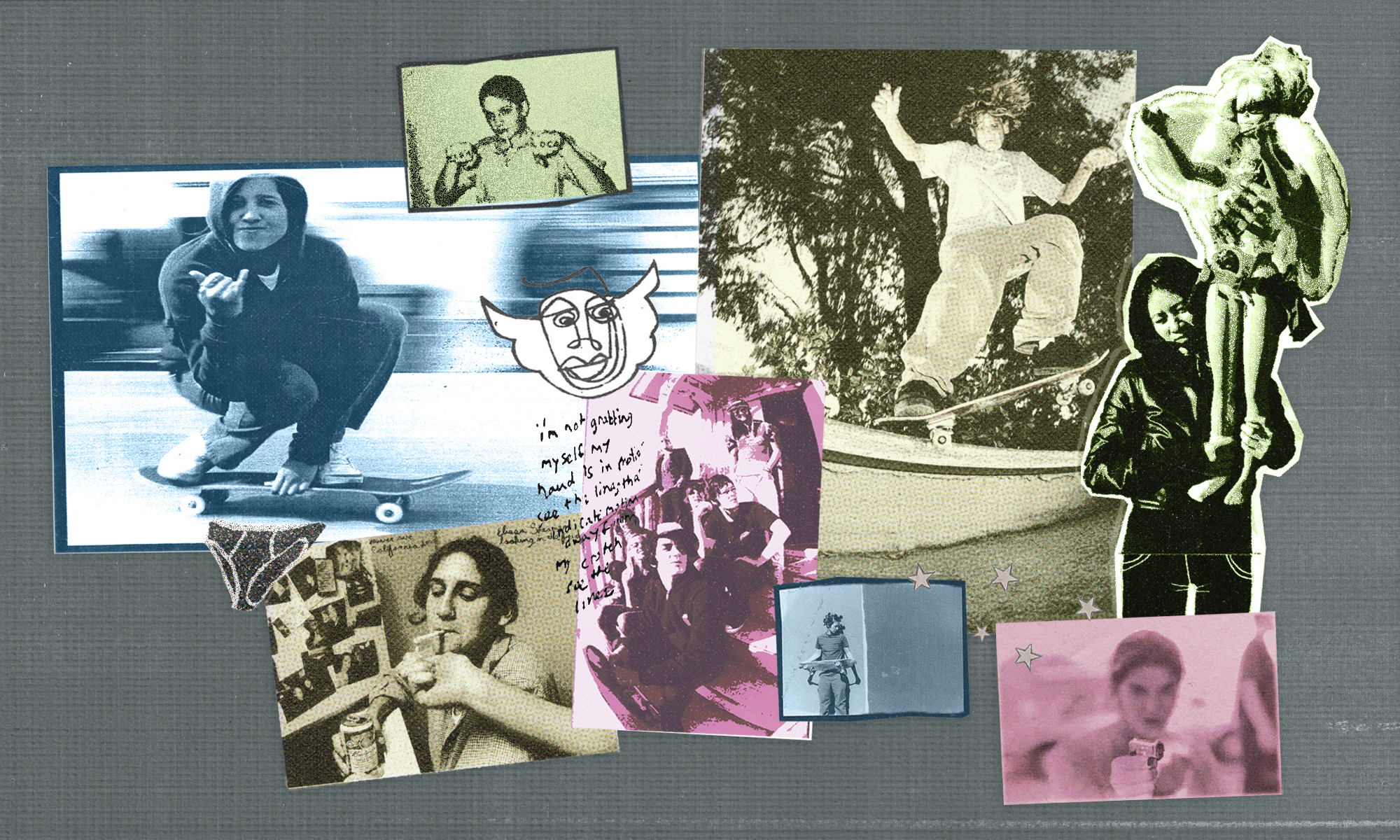
Let’s face it. The skateboarding industry has done a pretty terrible job documenting women’s skateboarding throughout the years. Scattered like a buck shot, the interviews, small circulation zines, and local newspaper stories featuring women have never been easy to find, nor have they been in one place.
That is, until Natalie Porter entered the picture. Natalie is the founder of Womxn Skateboard History, a website that serves to honor and remember the female skateboarders who paved the way and made the scene we have now possible.
She’s also a librarian and author of a brand new book, Girl Gangs, Zines, and Powerslides: A History of Badass Women Skateboarders.
To celebrate the release of her new book, Natalie offered to comb through her extensive archives to bring you sixteen things you didn’t know about women’s skate history.

THE FIRST GIRL GANG WAS CALLED “LA FEMME”
In 1963, after noticing their male friends getting sponsored, Colleen Boyd Turner, Donna Cash Harris and Suzie Rowland Levin formed the first skater girl gang called La Femme. La Femme was a women’s clothing shop who provided the girls with matching plaid jackets adorned with 10-inch back patches created by Suzie’s mom.
LAURIE TURNER WAS SKATEBOARDING’S FIRST FEMALE PHOTOGRAPHER
Laurie Turner DeMott was the first female skateboard photographer when she contributed photos of herself and her friends skating the Whittier school grounds in the Winter 1964 issue of The Quarterly Skateboarder, which was their first issue.

photo: various shots of La Femme, skateboarding’s first girl gang
UNITY SKATEBOARDS GOES WAY BACK
In 1975 there was a Unity Skateboard Team that also had an equitable approach like the Unity collective we know today. Unity was a surf/skate shop that sponsored Debi Eldredge, Andra Malczewski and Mary Zerkie. Before Laura Thornhill became a legendary 1970s freestyle champion and the first female pro with a signature board, she dreamed of riding for Unity.
VANS SHOES SPONSORED FEMALE SKATERS FROM THE GET-GO
In his memoir, Paul Van Doren explained how “Each Vans store manager was encouraged to choose seven or eight skateboarders and supply them with shoes.” Girls were welcomed to try-out, and in the 1970s, Sunshine Lee, Amy Pike Bradshaw, Yvonne Cucci, and Elaine Poirier were some of the youngest Vans riders, eventually followed by prominent skaters, including Cara-Beth Burnside.

photo: Laura Thornhill by James O’Mahoney
TRANS SKATER TERRY LAWRENCE INSPIRED CARA-BETH BURNSIDE TO SKATE IN THE 70S.
In an episode of Off the Wall TV, Cara-Beth explained to Jeff Grosso that in the mid-1970s she was roller-skating at the Holiday roller rink where she noticed the Powerflex team ripping it up, including Terry Lawrence. CB immediately ditched her rollerskates and took up skateboarding. Grosso interviewed Terry years later in the June 2020 episode of his “Love Letter to LGBTQ+” as a trans legend.
A GIRL SKATEBOARDING GANG OF THE 80S INSPIRED THRASHIN’
In the early 1980s, a skater girl gang called The Hags was terrorizing Los Angeles, receiving notoriety in newspapers like the L.A. Times and L.A. Weekly. They even inspired Alan Sacks to write a film script called “Skate or Die,” which became the cult classic film, Thrashin’.

photo: Cara-beth Burnside shot by Michele Peretti on left, Martin Willners on right
“SK8HERS” WAS THE FIRST ALL WOMEN’S VIDEO
Released in 1992, SK8HERS was produced by Ethan Fox who revered the female skaters of the 1970s and wanted to celebrate the progress being made. The 30-minute film included fourteen women, with Cara-Beth acting as narrator and feature skater. They had a launch party at Moose McGillycuddy’s in Marina Del Rey with friends and family, but not a single skate magazine celebrated their accomplishment or bothered to follow-up with interviews or photos.
LAURI KUULEI WONG HELPED PAY FOR TONY HAWK’S MORTGAGE
When Tony Hawk bought his first house, he needed some help with the mortgage and various friends rented rooms from him including Lauri Kuulei Wong, who worked at Del Mar skatepark. Lauri was the editor of the first female-focused skateboard zine called Ladies Skateworld starting in April 1986.

photo: Ladies Skateworld zine on left, Lori Rigsbee Independent ad on right
THE FIRST FEMALE BLACK PRO SKATER INSPIRED EQUAL TIME ZINE
Stephanie Person is revered for becoming the first female Black pro skater in 1988. Her article “Equal Time” for Poweredge Magazine in March 1989 regarding the treatment of female skaters became the inspiration for a new zine edited by Lynn Kramer and JoAnn Gillespie, also called Equal Time. The zine was the masthead for the 250 members of the Women’s Skateboard Network, motivating women around the world to claim space.
BRAZIL HAS A LONG HISTORY OF FEMALE SKATEBOARDERS
In Brazil, women like Maria Elaigne Ferriera back in the 1970s were among the pioneers, followed by skaters in the 80s like Monica Polistchuk who helped initiate a girls’ division at the 2nd Brazilian Championship in Guaratinguetá in 1983 and subsequent years. Liza Araujo started a zine in 1995 called Check it Out: Skateboarding 4 Girls. Joined by Paula Negrão and Luciana Toledo, they turned the zine into a glorious glossy magazine with 18 issues dedicated solely to women in skateboarding.

photo: Ana Paula, Liza Araujo and Elissa Steamer from Slap Magazine, May 2000
SLAM CITY JAM HOSTED A FEMALE STREET EVENT IN 1998
The organizers of Slam City Jam were petitioned by Megan Kelleher and a crew of local girls to include a street contest for women, which Elissa Steamer won. A vert contest was later added, and this set a precedent for other major contests like the Globe World Cup. The mainstream industry slowly realized that female skaters couldn’t be ignored or tokenized, although the popular magazines still struggled to show their support.
SKATE VIDEO GETTING NOWHERE FASTER WAS ALMOST A BONUS SECTION
The film, Getting Nowhere Faster was the brainchild of Lisa Whitaker and the Villa Villa Cola skate crew out of San Diego. Instead of a DVD bonus section, Josh Friedberg of 411VM and Johnny Schillereff of Element opted to sponsor a full video after witnessing the mass of talented female skaters. This would go on to be a game-changer for female skaters.

photo: various Villa Villa Cola zine scans
A NYC ART INSTALLATION RESULTED IN ROOKIE SKATEBOARDS
In November 1995, Catherine Lyons and Elska von Hatsfeldt met at a temporary vert ramp art installation inside the Brooklyn Bridge Anchorage. The scene was a bro fest, as Catherine remembers, “I was talking to the designer of the ramp, asking if there was some secret time that girls could come in and have access because it was so ridiculous!” This event and the lack of female representation led to Catherine and Elska’s creation of Rookie – a legendary 90s board company, known for its innovative design and diverse team.
BEFORE HOOPLA AND MEOW, CHERRY SKATEBOARDS HELD IT DOWN FOR WOMEN
Emily Oliver and Shodie Lyon of Breckenridge, Colorado, followed in the footsteps of Rookie and launched their own board company called Cherry in February 2003. Mainstream board companies were still hesitant to include female skaters, so Cherry sponsored talented riders like Alex White, Alexis Schempp, and Crystal Solomon.

photo: various Rookie Skateboards ads
BONNIE BLOUIN WAS THRASHER’S FIRST FEMALE COLUMNIST
Writing “Skater’s Edge” from 1986-1989, Bonnie Blouin had a fantastic run of articles. They covered a wide range of topics from dating, unstoked parents, road trips to rallying your skateboard community. Harper’s Magazine even re-printed Bonnie’s article “A Skateboarder’s Guide to Unstoked Parents,” where the advice switches between mom and dad and concludes with the statement, “Your parents will get the idea sooner or later, so keep your chin up and skate with pride.”
ERIC DRESSEN’S CHILDHOOD GIRLFRIEND WAS A BADASS
Canon “Bunny” Price competed in the “First Ever Pool Contest” at Anaheim, California’s Concrete Wave park. In the Girl’s category Price took home gold in Pool and Slalom, silver in Banked Slalom (or “snake run”), and Bronze in Freestyle, technically making her the first ever female skater to win a pool contest. Regarding Eric Dressen, her first official boyfriend, Bunny remembers, “He was younger than me and was super cute… He had pretty blonde hair and an impish grin. We definitely got into a lot of trouble.”
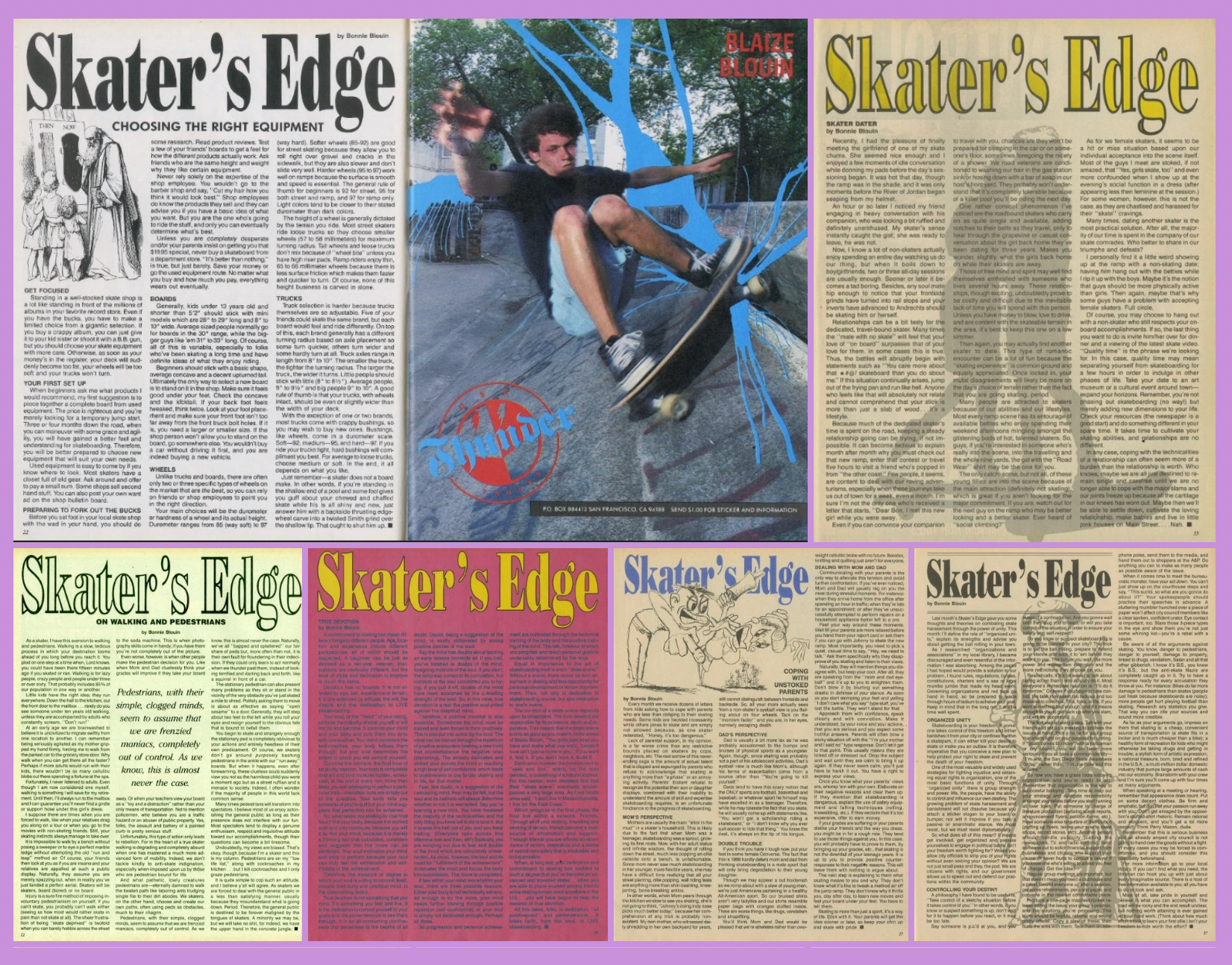
photo: a selection of Bonnie Blouin’s Thrasher column, “Skater’s Edge.”
The Shop


Related Posts
-
 A LOOK AT ONE OF THE MOST IMPRESSIVE PERSONAL SKATEBOARD COLLECTIONS
"Every dollar I save goes into skateboarding and collecting. It’s a borderline obsession or addiction."
-
 WE HAD THE INTERN REVIEW OUR LUNCHES
Our overly opinionated intern, Justin, always has a lot to say about our food choices, so we gave him free rein to pick apart our lunches.
-
 RANKING 10 OF THE BEST SKATE SHOP VIDEOS EVER MADE
As always, this is a scientific, peer reviewed essay and is absolutely the be-all-end-all list of worthwhile shop videos.
-
 THE HISTORY OF SKATEBOARDING’S MOST TABOO TRICK: THE BENIHANA
If you’ve ever wondered how far back the anti-benihana sentiment stems, you’re not alone.
-
 HAPPY HOLIDAYS FROM US
As it gets nippy and the sun gets lazier and lazier, we figure there’s no better time than now to take a short holiday hiatus.
-
 WHAT INSPIRES SOME OF SKATING’S BEST FILMMAKERS?
In-depth conversations about the worlds of filmmaking and skate video making.
-
 2024 PREDICTIONS: ANOTHER YEAR OF “EDUCATED” GUESSES
The crystal ball has malfunctioned in the past, but we're not ready to give up on our predictions just yet.
-
 UNSEEN PHOTOS OF SKATING NYC IN THE ’80S
Take a trip back to a time before iPhones and Instagram ruled the world.
Comments
Popular
-
 KEITH HUFNAGEL ON THE FUTURE OF HUF
We heard a rumor that HUF was going out of business, so we talked with boss man himself to find out.
-
 PARADE WORLD IS RETHINKING THE WAY YOU BUY SKATE GOODS ONLINE
Now you can buy skate goods online and support a local shop at the same time.
-
 THE DAY AFTER 9/11 THROUGH THE LENS OF SKATE PHOTOGRAPHER MIKE O’MEALLY
"The streets were so empty. People were kinda waving us on, it was a weird optimistic outlook."
-
 SKATERS RECOMMEND THEIR FAVORITE SKATE PANTS
We hit up some pro skaters and Jenkem contributors known for their 'fits to offer recommendations.
-
 GETTING KINKY WITH DANIEL VARGAS
Daniel Vargas' philosophy on whips, chains and getting choked out.
October 2, 2025 2:20 pm
What about TnT’s wife? Or Meg Baltimore doing Ruby through Crailtap. That was sick.
October 3, 2025 10:47 am
Awesome. I remember when Natalie showed up in Vancouver (though I wasn’t skating much at the time) in the early days around AntiSocial. I hope she talked to or mentioned Lisa Witski (sic?), the first female Jak. She was truly badass. Guess I’ll buy the book and find out.
October 6, 2025 7:06 pm
You’re in for a treat! There’s a whole chapter on Lisa Jak Wietzke in the book. Enjoy.
October 6, 2025 12:39 pm
it’s great seeing woman supporting woman
October 6, 2025 4:03 pm
I love this and learned some new stuff! A trans skater inspired Cara-Beth? Fuckin’ rad!! And Cherry was sick too! What ever happened to Summer La Clair?